
Conductive Hearing Loss: What Causes It, How It Feels, and How It’s Treated

Most cases of conductive hearing loss are temporary and respond well to treatment. Our audiologists in Lakeland and Winter Haven, FL are here to find the cause and get you hearing clearly again.
 Conductive hearing loss occurs when sound is blocked or cannot travel efficiently through the outer or middle ear to reach the inner ear. Unlike sensorineural hearing loss, which involves permanent damage to cochlear hair cells, conductive hearing loss is frequently caused by something that can be identified and treated: a buildup of earwax, a middle ear infection, a perforated eardrum, or a structural condition.
The result of that blockage is that sounds reach you muffled or quieter. For many people, successful treatment restores hearing fully or significantly.
At Aspire Hearing Solutions, our doctoral-level audiologists provide comprehensive evaluation and treatment for conductive hearing loss at our Lakeland and Winter Haven, FL offices, using advanced diagnostic tools and a patient-first approach.
What is conductive hearing loss?
Conductive hearing loss (CHL) is a type of hearing impairment that occurs when sound waves cannot travel efficiently through the outer ear canal, eardrum, or the small bones of the middle ear to reach the inner ear or cochlea.
When that pathway is blocked or damaged, the sound signal arriving at the inner ear is weakened. While the cochlea and auditory nerve may function appropriately, hearing loss results if sound cannot reach them effectively.
Symptoms of Conductive Hearing Loss
CHL is often described as listening through earplugs or underwater. While sounds are often present, the volume of sounds reaching the inner ear is affected.
Common symptoms include:
- Muffled or dulled sounds
- Voices that sound mumbled or unclear
- A feeling of fullness, pressure, or blockage in one or both ears
- Pain or discomfort in the ear (particularly if caused by infection)
- Difficulty hearing conversations, especially in noisy settings
- Hearing improves when sounds are louder
- Ringing, buzzing, or popping sounds in the ear (tinnitus)
- Drainage or fluid from the ear canal
- Noticing that your own voice sounds unusually loud or different inside your head
- Balance problems or dizziness (particularly with middle ear fluid or infection)
One distinguishing feature of conductive hearing loss, and an important clue for audiologists, is that the clarity of speech is often preserved. People experiencing CHL typically report that they can hear that someone is speaking, but the volume is too low. This contrasts with sensorineural hearing loss, where the brain receives sound but cannot always make it out clearly.
Who develops conductive hearing loss?
Conductive hearing loss affects people of all ages. CHL is the most common cause of hearing loss in young children, often due to middle ear infections (otitis media) and fluid buildup. In adults, it is more commonly associated with earwax impaction, ear infections, structural damage from injury, or conditions like otosclerosis.
While conductive hearing loss is less common than sensorineural hearing loss, it is frequently treatable. Many people with CHL can have their hearing fully or substantially restored.
How is conductive hearing loss diagnosed, and what causes it?
Diagnosing conductive hearing loss requires a comprehensive audiological and medical evaluation. CHL can be caused by a wide range of conditions that affect the outer ear, ear canal, eardrum, or middle ear bones. Our audiologists use a combination of physical examination, hearing tests, and imaging studies to pinpoint the cause and determine the appropriate treatment approach.
Common causes of CHL can include:
Earwax Buildup (Cerumen Impaction)
Middle Ear Infections (Otitis Media)
Fluid in the Middle Ear (Otitis Media with Effusion | “Glue Ear”)
Also called “glue ear” or secretory otitis media, this condition involves non-infected fluid that remains in the middle ear after a cold, allergy, or ear infection. It is the leading cause of temporary hearing difficulties in children. If left untreated, it can affect speech and language development. In adults, persistent middle ear effusion can warrant further investigation.
Eustachian Tube Dysfunction
The Eustachian tube connects the middle ear to the back of the throat and regulates middle ear pressure. When it fails to open and close properly due to allergies, colds, sinus issues, or anatomical factors, pressure builds in the middle ear, creating a feeling of fullness and reducing hearing clarity. Frequent flyers often experience a mild version of this during takeoff and landing.
Perforated Eardrum (Tympanic Membrane Perforation)
Otosclerosis
Cholesteatoma
Outer Ear Infections (Swimmer's Ear | Otitis Externa)
Foreign Objects in the Ear Canal
Congenital Causes
Some people are born with structural abnormalities of the outer or middle ear that cause conductive hearing loss from birth. These include microtia (underdeveloped outer ear), aural atresia (absent or closed ear canal), and malformation of the ossicles. Bone-anchored hearing systems (BAHAs) are often used in these cases, as conventional hearing aids may not be possible.
Head Trauma and Barotrauma
Physical injury can dislocate or fracture the ossicles, causing CHL that may require surgical reconstruction (ossiculoplasty). Barotrauma, which is caused by rapid changes in air pressure (diving, flying, explosions), can also damage the eardrum or cause fluid accumulation in the middle ear.
What to Expect at Your Evaluation
Medical and hearing history review
Physical ear examination
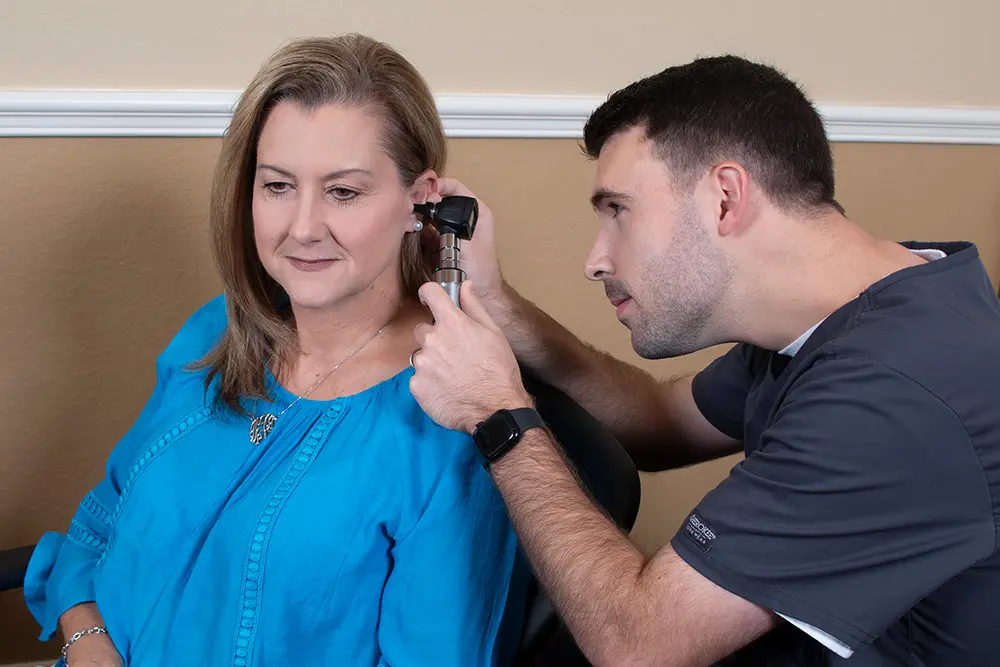
Using an otoscope, your audiologist will visually examine your ear canal and eardrum for blockages, inflammation, fluid, perforations, or other abnormalities.
Pure tone audiometry
Tympanometry
Tympanometry is a quick, painless test to measure how the eardrum responds to air pressure changes. It provides objective information about middle ear pressure, fluid, and eardrum mobility. Abnormal results can indicate fluid, a perforation, or ossicular chain problems.
Acoustic reflex testing
Acoustic reflex test measures the automatic contraction of a small muscle in the middle ear in response to loud sounds. Absent reflexes can indicate middle ear disease or problems with the ossicular chain.
Speech audiometry
The speech audiometry test gauges your ability to understand speech at various volume levels, helping to characterize the practical impact of the hearing loss.
Conductive Hearing Loss Treatment Options
Treatment for conductive hearing loss is highly cause-dependent. The earlier CHL is identified and the underlying cause addressed, the better the outcome. Delays in treatment, particularly in children, can allow temporary hearing loss to become a prolonged period of auditory deprivation with lasting consequences.
Most cases of conductive hearing loss can be significantly improved or fully resolved with appropriate treatment. The prognosis depends heavily on the underlying cause, how long it has been present, and how promptly it is treated.
Common CHL treatments include:
1. Earwax Removal
Professional earwax impaction removal can be done by irrigation, manual removal with instruments, or micro-suction. Results are typically immediate, and hearing returns to normal as soon as the blockage is cleared. We offer professional earwax management at both our Lakeland and Winter Haven locations.
2. Conventional Hearing Aids
For conductive hearing loss that cannot be fully corrected medically or surgically, or while waiting for surgical intervention, conventional hearing aids can significantly amplify sound and improve communication. Even modest amplification can be highly effective in CHL because the inner ear and nerve are typically intact.
3. Bone-Anchored Hearing Devices (BAHAs)
4. Assistive Listening Devices (ALDs)
In some situations, assistive listening devices can supplement treatment or bridge the gap during recovery. These include amplified telephones, TV listening systems, FM systems for classroom use, and Bluetooth-enabled devices that stream audio directly to hearing aids.
If surgery, medication or treatment that is out of scope for our office is identified, your provider will refer you to an Ear Nose and Throat specialist for further review.
Can conductive hearing loss be prevented?
Not all conductive hearing loss can be prevented. Some causes, like genetic conditions or certain injuries, are outside our control. However, many common causes are preventable or can be caught early with good ear care and regular hearing checks.
- Avoid putting cotton swabs and other objects into the ear canal.
- Seek treatment for ear infections early and follow up to ensure fluid has resolved.
- Promptly address chronic ear problems, such as fluid and recurrent infection.
- Manage seasonal allergies, as Eustachian tube dysfunction is worsened by untreated allergies.
- Protect against swimmer’s ear with ear plugs and dry ears thoroughly after swimming.
- Schedule hearing evaluations every 1–3 years to catch changes before they become problems.
For more on protecting your hearing long-term, see our full guide.
Take the First Step Toward Clearer Hearing
If you have been told you have conductive hearing loss or are experiencing muffled sounds, ear fullness, pain, or any other signs of hearing change, do not wait. Most conductive hearing loss is treatable, and the sooner it is evaluated, the better your outcomes.
Scheduling a comprehensive hearing evaluation at Aspire Hearing Solutions is quick and easy. Our team will identify the cause of your hearing loss, explain your options clearly, and work with you to create a treatment plan that fits your life.
Frequently Asked Questions: Conductive Hearing Loss
Is conductive hearing loss permanent?
Not usually. Most cases of conductive hearing loss are temporary and respond well to treatment. Whether your hearing returns depends entirely on the underlying cause. Earwax or an ear infection will typically resolve fully with treatment, while conditions like otosclerosis or ossicular damage may require surgery. Even in cases that cannot be fully corrected medically, hearing aids or bone-anchored devices provide excellent hearing improvement. The most important step is getting evaluated promptly so the cause can be identified and addressed.
What is the most common cause of conductive hearing loss?
In children, middle ear infection with fluid buildup is by far the most common cause. In adults, earwax impaction is among the most frequent causes, along with middle ear infection, Eustachian tube dysfunction, and otosclerosis for adults with no history of ear infections.
Can conductive hearing loss get worse if left untreated?
Yes, and sometimes significantly so. An untreated ear infection can lead to chronic middle ear disease, eardrum perforation, or cholesteatoma. Untreated cholesteatoma is destructive and will progress, eroding the ossicles and potentially damaging the inner ear or facial nerve. Otosclerosis also tends to progress over time. In children, even temporary conductive hearing loss that persists can affect speech and language development if unaddressed. Early treatment consistently leads to better outcomes.
How is conductive hearing loss diagnosed?
Diagnosis involves a combination of a physical ear examination, pure tone audiometry (hearing test), bone conduction testing, and tympanometry. The key finding is an air-bone gap, a measurable difference between how well you hear through air conduction versus bone conduction, which confirms the hearing loss has a conductive component. Imaging (CT or MRI) may be ordered by a physician for more complex cases.
What is the difference between conductive and sensorineural hearing loss?
Conductive hearing loss is a problem with the mechanical delivery of sound through the outer and middle ear. Sensorineural hearing loss is a problem with the inner ear’s hair cells or the auditory nerve. Conductive loss is often reversible; sensorineural loss is usually permanent but manageable. Mixed hearing loss involves elements of both.
Can adults get conductive hearing loss from ear infections?
Yes. While middle ear infections are most common in children, adults can and do develop them, particularly following upper respiratory infections, air travel, or significant allergies that impair Eustachian tube function. Adults who develop a middle ear effusion (fluid) that does not resolve should have it evaluated, as persistent fluid in one ear in an adult can occasionally indicate a more serious underlying condition.
Does conductive hearing loss affect both ears?
It can affect one ear (unilateral) or both ears (bilateral), depending on the cause. Earwax buildup, for example, can affect just one side. Otosclerosis typically affects both ears, though often one side more than the other. Your audiologist will test each ear individually to determine the extent and symmetry of the hearing loss.
Do I need surgery for conductive hearing loss?
Not necessarily. Many cases resolve with medication (antibiotics for infections) or simple procedures like earwax removal or ear tube insertion. Surgery is recommended when the cause is structural, such as a perforated eardrum, otosclerosis, cholesteatoma, or ossicular damage. Your audiologist and treating physician will discuss the most appropriate approach based on your specific diagnosis.
Can conductive hearing loss cause tinnitus?
Yes. Tinnitus (ringing, buzzing, or other sounds in the ear) is a common companion to conductive hearing loss, particularly in cases involving ear infections, fluid in the middle ear, or otosclerosis. In many cases, treating the underlying cause of the conductive hearing loss also reduces or eliminates the tinnitus. If tinnitus persists, dedicated tinnitus treatment options are available. Learn about tinnitus treatment →
How long does it take to recover hearing after treatment?
Recovery time varies by cause and treatment. Hearing typically returns immediately after earwax removal. Ear infections usually clear over 1–2 weeks with antibiotics. Recovery from eardrum repair surgery (tympanoplasty) can take 4–8 weeks. Following stapedectomy for otosclerosis, patients often notice improvement within days, with full recovery over several weeks to months. Your audiologist will set realistic expectations based on your specific situation.