
Bone-Anchored Hearing Aids (BAHAs) in Lakeland, FL
For people with certain types of hearing loss, particularly those who can’t benefit from conventional hearing aids or who have profound loss in one ear, a bone-anchored hearing aid (BAHA) can deliver a level of clarity that traditional amplification simply can’t achieve. At Aspire Hearing Solutions, we work with patients across the Lakeland and Winter Haven area to evaluate candidacy, guide device selection, and support your hearing from initial trial through long-term follow-up care.
How a Bone-Anchored Hearing Aid Works
Here’s a quick way to understand bone conduction hearing: plug your ears with your fingers and hum. You can still hear yourself clearly because that sound is traveling through the bones of your skull directly to your inner ear, bypassing your ear canal entirely. That’s the same principle a bone-anchored hearing aid uses.
Conventional hearing aids amplify sound and direct it through the ear canal and middle ear to reach the cochlea (the inner ear). This pathway works well when the middle and outer ear are functioning normally. But when the ear canal is malformed, the middle ear is chronically infected or structurally damaged, or one ear simply can’t receive sound, that air conduction pathway becomes a barrier, not a benefit.
A BAHA bypasses all of that. The external sound processor captures sound, converts it into gentle vibrations, and transmits those vibrations through the skull bone directly to the cochlea. Because the inner ear receives the signal directly, the quality and clarity of sound is markedly better than what you’d get trying to amplify sound through a damaged or obstructed pathway.

Who is a candidate?
BAHAs are FDA-approved for three main candidacy categories. You may be a candidate if you have:
Conductive or Mixed Hearing Loss
Conductive hearing loss occurs when sound can’t pass freely through the outer or middle ear, while mixed hearing loss combines this with a sensorineural component. A BAHA can address these conditions by routing sound directly to a functional cochlea, bypassing the blockage. Common causes appropriate for BAHA include congenital ear canal malformation, chronic middle ear infections, cholesteatoma, and chronic ear drainage that make conventional hearing aids uncomfortable or medically inadvisable.
Single-Sided Deafness (SSD)
Cannot Wear a Conventional Hearing Aid
For patients whose sensorineural hearing loss could otherwise be helped by a standard hearing aid but whose chronic skin conditions, persistent ear drainage, or ear canal anatomy make wearing an in-the-ear or behind-the-ear device impractical, a BAHA offers a comfortable solution without anything in the ear canal.
An important clarification: BAHAs are not recommended for bilateral sensorineural hearing loss (both cochleae are significantly damaged). However, single-sided deafness, even when the cause is sensorineural, is a primary BAHA indication. If you have significant loss in one ear and have been told you’re not a candidate for anything, please schedule a consultation. Single-sided deafness is one of the most common and successfully treated conditions with BAHA.
BAHA vs. Conventional Hearing Aids
If you have conductive or mixed hearing loss, you may wonder whether a conventional hearing aid could work just as well. In some cases it can, but for many patients with these conditions, a BAHA provides a meaningfully better result.
No device in the ear canal
Many patients with chronic ear infections or drainage cannot tolerate a hearing aid sitting in or over the ear canal. A BAHA processor sits on the skull, behind the ear, with nothing placed inside the canal. This eliminates the discomfort, feedback, and hygiene challenges that conventional aids create for ears that are already irritated.
No occlusion
The “plugged up” feeling some hearing aid wearers experience (where their own voice sounds boomy or hollow) doesn’t occur with a BAHA because the ear canal remains completely open.
Sound quality for damaged pathways
When sound has to travel through a damaged or obstructed outer or middle ear, amplifying it doesn’t fix the underlying transmission problem. Routing the signal directly to the cochlea through bone conduction bypasses the obstacle entirely, often resulting in significantly clearer sound.
For single-sided deafness, a hearing aid isn’t an option
A conventional hearing aid worn on a non-functioning ear provides no meaningful benefit as the inner ear on that side can’t use it. A BAHA routes sound to the working ear through the skull, which a hearing aid cannot do.
Surgical and Non-Surgical Options
One of the most important things to know about BAHAs is that surgery is not the only option, and it’s never the first step. Before any surgical decision is made, you can trial the technology.
Non-Surgical Trial
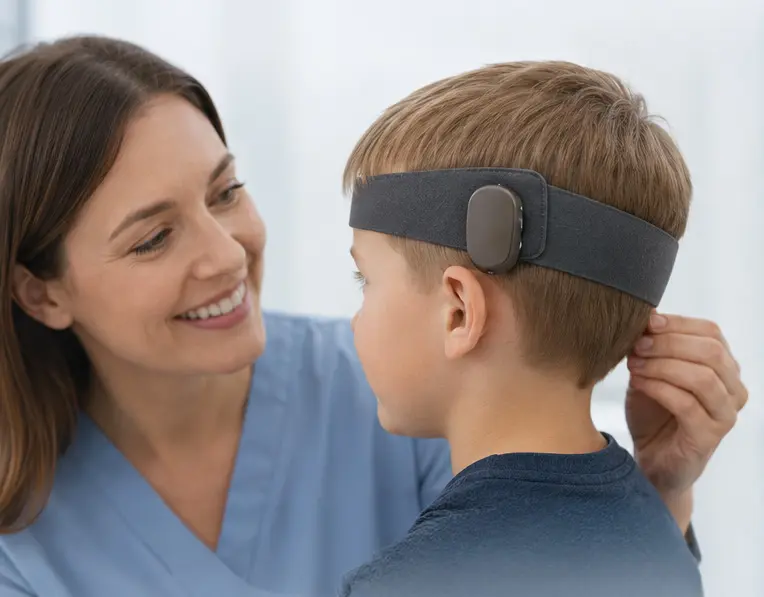 During your evaluation at Aspire Hearing Solutions, we can attach a BAHA processor to a softband or headband, so you can experience bone conduction hearing before a commitment. This trial lets you hear what the technology sounds like for your specific hearing loss profile, in a real-world setting, with no surgical risk. It’s an extremely useful and reassuring part of the process. Most patients leave the trial appointment with a much clearer picture of whether a BAHA is right for them.
Non-surgical wear using a softband is also the standard approach for young children whose skull bone is not yet developed enough to support a surgical implant. Children can use the softband device to access sound during early language development years, then transition to the surgical system when they’re old enough.
Surgical Options
Surgical implantation is a relatively minor outpatient procedure, typically under an hour, in which an ENT surgeon or neurotologist places a small titanium implant (three–four millimeters) into the bone behind the ear. Over the following weeks, the bone fuses to the titanium through osseointegration, creating a stable anchor for the external processor.
There are two main connection styles: percutaneous (abutment) systems, which use a small post that protrudes through the skin for efficient vibration transfer; while transcutaneous (magnetic) systems sit entirely beneath the skin and connect via magnet, eliminating any open skin site. Your audiologist and ENT will help determine which style best fits your anatomy, hearing loss profile, and personal preferences.
The Systems We Support
Aspire Hearing Solutions works with the two leading BAHA manufacturers, giving patients the opportunity to demo and compare systems before making a decision.
- Cochlear Americas offers two distinct bone conduction systems. The BAHA Connect is a percutaneous system using an abutment connection, a well-established with a long clinical track record and known for efficient, direct vibration transfer. The Osia system is Cochlear’s transcutaneous option, featuring an active implant with no protruding abutment and a modern magnetic processor connection. The Osia is particularly popular with patients who prioritize a cleaner look and no external skin site.
- Oticon Medical / Ponto offers the Ponto series of percutaneous bone-anchored devices. The Ponto is recognized for its natural sound quality and is among the smallest and most discreet BAHA processors available. It supports full wireless connectivity including direct streaming and comes in a range of power levels to accommodate varying degrees of hearing loss.
Both manufacturers offer companion smartphone apps for wireless control, volume and program adjustments, and direct audio streaming from compatible devices. Our audiologist will walk you through the features of each system and help you demo the options most appropriate for your hearing profile.
What to Expect: Your Step-by-Step Journey
The BAHA journey at Aspire Hearing Solutions begins with a comprehensive audiological assessment to determine the type, degree, and configuration of your hearing loss and whether a BAHA is appropriate. Following that, you will have in-office trial during which you’ll wear a processor on a softband to experience bone conduction sound firsthand before any surgical decision is made. If the trial is positive, you’ll be referred to an ENT surgeon or neurotologist for medical evaluation and candidacy confirmation, after which outpatient surgery (typically under an hour) places the implant, with normal activity resuming within days.
In one to three months after the procedure, the bone fuses to the implant through osseointegration. After this initial recovery, you’ll return to have your permanent external processor fitted and programmed, often with immediately noticeable improvement over the trial. From there, follow-up appointments ensure optimal programming as your hearing progresses, and future upgrades to newer processor technology are typically possible without additional surgery.
Insurance and Coverage
BAHAs are FDA-approved medical devices and are covered by Medicare, and most private health insurance plans when medically indicated. Unlike conventional hearing aids, which are excluded from most insurance coverage, bone-anchored systems are generally treated as medically necessary implantable devices when candidacy criteria are met.
Medicare covers BAHA surgery and the device for eligible beneficiaries. Private insurer coverage varies by plan, but prior authorization is typically required. Our team can assist with navigating the pre-authorization process and helping you understand what to expect in terms of out-of-pocket costs before you commit to anything.
Frequently Asked Questions
Do I have to have surgery to get a BAHA?
Not to try one. We can fit you with a BAHA processor on a softband during your evaluation appointment so you can experience the technology before any surgical decision is made. Surgery is only pursued if you choose to proceed after the trial and a full candidacy assessment.
Will the implant be visible?
The titanium implant itself is small, just a few millimeters, and sits beneath the hairline. Whether you have a small abutment post (percutaneous system) or no external component at all (transcutaneous/magnetic system) depends on the device you choose. The external sound processor is worn behind the ear and is comparable in size to a standard behind-the-ear hearing aid.
How long does it take to heal after surgery?
Osseointegration, the process of your bone fusing to the titanium implant, typically takes one to three months. During this period you can still use a softband processor, so your hearing isn’t interrupted. Physical recovery from the procedure itself is usually just a few days.
How is a BAHA different from a cochlear implant?
Both devices use implanted components, but they work very differently and treat different conditions. A BAHA uses bone conduction to route sound to a functioning cochlea. A cochlear implant bypasses a damaged cochlea entirely and stimulates the auditory nerve directly as it’s designed for people with significant sensorineural hearing loss in both ears. Your audiologist can help you understand which technology, if either, is appropriate for your situation.
I have hearing loss in only one ear. Can a BAHA help me?
Quite possibly, yes. Single-sided deafness is one of the primary indications for BAHA. A BAHA worn on your non-hearing side can transmit sound through the skull to your functioning ear, helping you hear sound from both sides and reducing the difficulty of conversations in noise or at a distance. Come in for an evaluation and an in-office trial. The demonstration is the best way to know whether the improvement would be meaningful for your daily life.
Is the procedure reversible?
Yes. Unlike cochlear implantation, BAHA surgery does not alter or damage the middle or inner ear. If you later decide to remove the implant, it can be removed without compromising any residual hearing you have. The procedure also doesn’t preclude future hearing technology options.

Find Out If a BAHA Is Right for You
If you’ve been struggling with hearing loss due to chronic ear problems, a malformed ear canal, or profound loss in one ear, and conventional hearing aids haven’t delivered the results you hoped for, a bone-anchored system may be worth exploring. The in-office trial means you can hear the difference for yourself before making any commitment.
Our team at Aspire Hearing Solutions serves patients across Lakeland, Winter Haven, and the surrounding Central Florida area. We’re here to guide you through every step, from your first evaluation to your long-term follow-up care.
Call Lakeland at 863-450-1179 or Winter Haven at 863-594-1978, or request an appointment online to schedule your evaluation.