
Cochlear Implants in Lakeland and Winter Haven, FL
For people with significant hearing loss who aren’t getting enough benefit from hearing aids, a cochlear implant can be life-changing. At Aspire Hearing Solutions, our board-certified audiologist is the only provider in Lakeland, FL who can program and service all three cochlear implant manufacturers: Advanced Bionics, Cochlear Americas, and MED-EL. That means wherever your hearing journey takes you, we can support you through every stage: evaluation, activation, programming, and long-term care.
What is a cochlear implant?
A cochlear implant is an electronic hearing device designed for people with sensorineural hearing loss, the most common type of permanent hearing loss, typically caused by aging, noise exposure, or certain medical conditions. With sensorineural hearing loss, the hair cells of the inner ear are damaged and can no longer send clear signals to the brain. A cochlear implant works by bypassing those damaged hair cells entirely and stimulating the auditory nerve directly.
It’s important to understand what a cochlear implant does and what it doesn’t do. It does not restore hearing to what it was before. What it does is provide the sensation of sound in a new way, allowing most recipients to significantly improve their ability to understand speech and engage in everyday conversation. For many people, the improvement over what hearing aids could provide is dramatic.
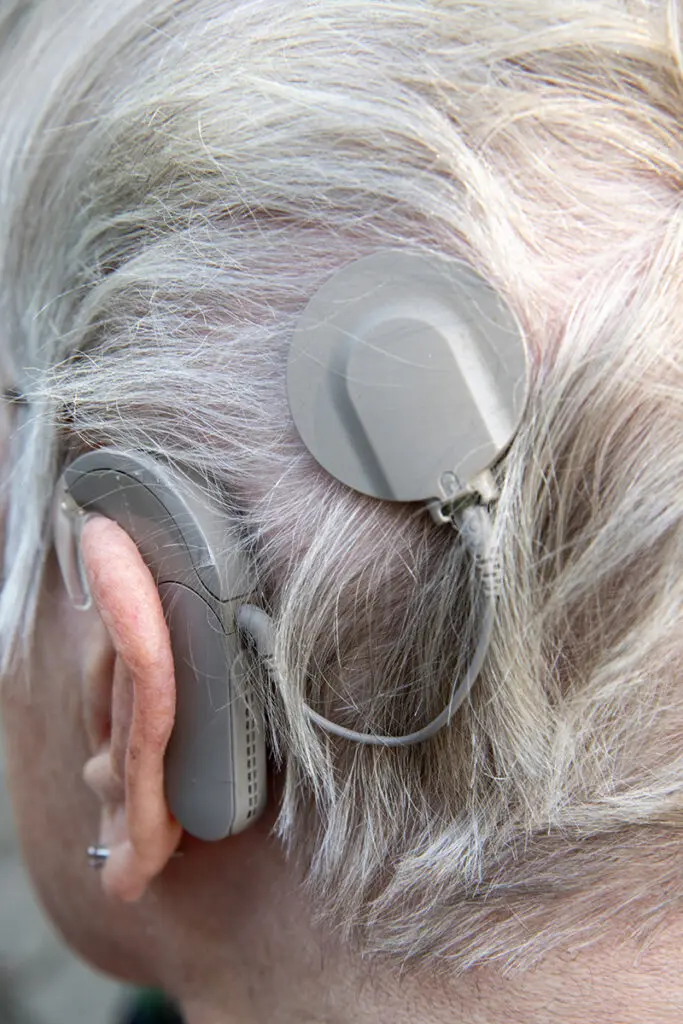
A cochlear implant has two parts. The internal component, a receiver and an array of electrodes, is surgically placed under the skin behind the ear during an outpatient procedure. The external component, a sound processor worn on or behind the ear, captures sounds from the environment and sends them wirelessly to the internal device, which then converts them into electrical signals that stimulate the auditory nerve.
Could you be a candidate?
One of the most common misconceptions about cochlear implants is that they’re only for people who are completely or profoundly deaf. That hasn’t been true for some time, and recent changes in Medicare coverage criteria have made even more people eligible than before.
You may be a candidate for a cochlear implant evaluation if:
- You have sensorineural hearing loss in one or both ears
- You’re not getting enough benefit from properly fitted hearing aids, meaning you still struggle to understand speech, especially in noise
- Hearing difficulty is affecting your quality of life, your relationships, or your ability to work
Cochlear implants are an option for both children and adults, and there is no upper age limit. In fact, the American Academy of Audiology notes that cochlear implants are not a last resort. They are an option when hearing aids are no longer providing sufficient benefit, regardless of how severe the loss is.
The formal evaluation process includes audiological testing with and without hearing aids, speech recognition testing, and a medical assessment by an ear, nose, and throat specialist (ENT) or neurotologist. Imaging studies, such as a CT scan or MRI, are also used to assess the anatomy of the inner ear and ensure the cochlea and auditory nerve are suitable for implantation.
If you’re unsure whether you or a family member might qualify, the best first step is a conversation with our audiologist. Many people are surprised to learn they’re candidates, and many more have been told in the past that they don’t qualify, only to find that updated criteria now include them.
Cochlear Implants vs. Hearing Aids
Hearing aids amplify sound. They make sounds louder, and when well-fitted, they can meaningfully improve hearing for many people. But hearing aids depend on the inner ear’s hair cells still being functional enough to receive and transmit that amplified signal to the brain. When those hair cells are significantly damaged, no amount of amplification can fully compensate.
A cochlear implant takes a different approach. Instead of making sound louder, it converts sound into electrical impulses and delivers them directly to the auditory nerve, bypassing the damaged hair cells altogether. For people whose hair cells are no longer doing their job, this direct-to-nerve pathway can achieve clarity that hearing aids simply can’t provide.
The two technologies are not in competition. Some people continue to wear a hearing aid in their non-implanted ear while using a cochlear implant in the other, which is a combination that many recipients find provides the best overall hearing experience. Your audiologist will help you understand which approach, or combination of approaches, is right for your specific pattern of hearing loss.
The Three Cochlear Implant Manufacturers
There are three FDA-approved cochlear implant manufacturers available in the United States, and each produces a family of implants and sound processors with different features, form factors, and connectivity options. Part of the candidacy and pre-surgery process involves choosing the device that best fits your lifestyle, hearing needs, and long-term goals.


Aspire Hearing Solutions’ board-certified audiologist is the only provider in Lakeland who is trained and equipped to program and service all three systems. This matters because cochlear implant programming, known as “mapping”, is a highly specialized skill, and your ability to get the most out of your device depends entirely on the expertise and availability of your programming audiologist. Patients who receive their implant at a large hospital but live in the Lakeland area often turn to Aspire Hearing Solutions for their ongoing programming needs, rather than traveling long distances for every follow-up appointment.
Aspire’s Role: Before and After Surgery
Cochlear implant surgery is performed by an ENT surgeon or neurotologist rather than by your audiologist. But your audiologist is central to the process at every other stage, and the quality of your outcomes is closely tied to the quality of your audiological care before and after the procedure.
Before surgery, our audiologist conducts the hearing evaluations that determine your candidacy, works with you to understand your hearing goals, helps you navigate the device selection process, and coordinates with your surgical team.
After surgery, the audiologist’s role becomes even more critical. Once the implant site has healed, typically three to four weeks after surgery, you’ll return to Aspire Hearing Solutions for your activation appointment, where your external sound processor is fitted and switched on for the first time. This is often an emotional and memorable moment for patients and their families.
From there, the audiologist programs your device through a process called mapping or adjusting how the implant delivers electrical signals to your auditory nerve to match your specific hearing profile. In the weeks and months that follow, multiple mapping appointments are needed to fine-tune the device as your brain adapts to hearing in this new way. Most patients have four to six programming appointments in the first year, with ongoing annual check-ins as needed after that.
Your audiologist also monitors your hearing progress over time, troubleshoots any issues with the device, and helps you access aural rehabilitation resources to support your adjustment to the implant.
What to Expect: Your Step-by-Step Journey
At Aspire Hearing Solutions, your cochlear implant journey begins with a comprehensive hearing evaluation. Tests will include those for speech recognition with and without current hearing aids; reviewing hearing history; and a medical candidacy assessment with an ENT or neurotologist, including imaging, if necessary. After confirming your candidacy and insurance pre-authorization, our audiologist will help you select the device and processor that best fits your needs. You’ll then undergo outpatient surgery (about two hours, under general anesthesia) to place the internal implant.
After a three-to-four-week healing period, the external processor is fitted and activated for the first time. Sounds may initially seem unfamiliar as your brain adjusts. In the following months, regular mapping appointments will help fine-tune the device while aural rehabilitation helps you get the most from your hearing. Most patients experience meaningful improvement within weeks and continued gains for a year or more. Ongoing care then shifts to annual check-ins and reprogramming. Future upgrades to newer processor technology are often possible without additional surgery.
Insurance and Coverage
Cochlear implants are covered by Medicare and most private health insurance plans, unlike hearing aids, which are typically not covered. This is one of the important practical differences between the two technologies that many patients don’t know about until they explore their options.
Medicare
Medicare covers cochlear implantation for adults with bilateral sensorineural hearing loss who demonstrate limited benefit from amplification. Medicare’s coverage criteria were expanded in September 2022, meaning more people now qualify than under previous guidelines. If you were evaluated in the past and told you didn’t meet Medicare criteria, it’s worth being re-evaluated under the updated standards.
Private Insurance
Private insurance plans generally cover cochlear implants as medically necessary devices, though out-of-pocket costs, prior authorization requirements, and coverage details vary by plan. We can help you navigate the pre-authorization process and understand what to expect financially before moving forward.
Frequently Asked Questions
Is a cochlear implant my only option if hearing aids aren’t working well enough?
Not necessarily. Depending on your type and degree of hearing loss, other solutions, such as bone-anchored hearing aids (BAHAs), may also be worth exploring. Our audiologist will help you understand all appropriate options for your specific situation.
How long does cochlear implant surgery take?
The procedure typically takes about two hours per ear and is performed as outpatient surgery under general anesthesia. Most patients go home the same day and recover within a few days to a week.
Will I hear normally after getting a cochlear implant?
A cochlear implant does not restore normal hearing. It provides a new way of perceiving sound that allows most recipients to significantly improve their speech understanding and ability to communicate. Results vary by individual, including factors like duration of hearing loss, age at implantation, and commitment to rehabilitation all influence outcomes. For many people, the improvement over unaided or hearing-aid-aided hearing is very significant.
What is “mapping,” and why do I need multiple appointments?
Mapping is the process of programming your cochlear implant’s sound processor, adjusting how electrical signals are delivered to your auditory nerve to best match your hearing profile and comfort level. Because your brain’s response to the implant changes as it adapts to the new signal, mapping needs to be adjusted regularly, particularly in the first year. It’s a normal and expected part of the process, not a sign that something is wrong.
I was previously told I don’t qualify for a cochlear implant. Should I try again?
Possibly. Candidacy criteria have evolved, including Medicare’s expanded coverage standards in 2022, and what was true several years ago may no longer apply. Additionally, if your hearing has progressed since you were last evaluated, your profile may have changed. We encourage anyone who was previously told they don’t qualify to come in for a fresh evaluation.
Am I too old for a cochlear implant?
No. There is no upper age limit for cochlear implantation. Older adults can and do achieve meaningful outcomes from cochlear implants, and for many, the quality-of-life improvements, including reduced social isolation, improved communication, and reduced cognitive load, are particularly significant.
Does Aspire Hearing Solutions perform the cochlear implant surgery?
No. The surgical implantation is performed by an ENT surgeon or neurotologist at a surgical facility. Aspire Hearing Solutions’s role is in the audiological care surrounding surgery, such as candidacy evaluation, device selection, activation, programming, and long-term follow-up. If you’re ready to explore candidacy, we’ll connect you with the appropriate surgical team.

Ready to Find Out If You’re a Candidate?
Cochlear implants have helped hundreds of thousands of people hear more clearly, including many who spent years believing they had no further options. If you or a family member has been struggling with hearing loss despite using hearing aids, a conversation with our audiologist is the best place to start.
As the only provider in Lakeland equipped to program and service all three cochlear implant manufacturers, Aspire Hearing Solutions offers a level of expertise and continuity of care that’s hard to find locally. We’re here to guide you through every step of the process, from your first evaluation to your ongoing care years after activation.
Call Lakeland at 863-450-1179 or Winter Haven at 863-594-1978, or request an appointment online to schedule your evaluation.